
Kingbull Jumper Go
MSRP $1,499.00
Released January 2025

“The Jumper Go has plenty of character and is an incredible value.”
Pros
- Dual Suspension
- Four-disc brakes
- Lots of character
- Incredible value
Cons
- Short seat post
- Thin instructions
Quick Take
It’s no surprise that budget eBike brands often will skip full suspension hardware, and you can see why. It costs money, adds weight, and most buyers in this category will never utilize the advantages of a dual suspension setup. The Kingbull Jumper Go got my attention for a number of reasons. First, I love the design with the large retro motorcycle-looking headlight on the front. It has a DNM air shock in the back, is a step-through (my preference for bikes you ride around town) frame and 20-inch fat tires. And while Kingbull claims this is the world’s first bike to combine these features (it’s not. Magicycle has had a full suspension since 2023), the Jumper Go is still unusual enough at this price point to make me pay attention.
Originally at a list price of $2,499, you can now find the Jumper Go online for around $1499 which is a steal, and it undercuts the Aventon Aventure 3 and the Velotric Nomad 2 by five hundred bucks while offering rear suspension, which neither of those models has. The 750W Bafang hub motor is a great brand that pulls hard up hills. And the torque sensor makes it feel like a bicycle to me rather than an electric scooter. You also get Tektro four-piston brakes, which is amazing for this price range. I found that the 960Wh battery lasted pretty well for my hilly neighborhood, and did great on the open flat roads.
While the Jumper Go will hit Class 3 level speeds at 28MPh, I think the ride quality, design, and plush suspension are what you should really be buying this bike for. If pure speed and torque are more your thing, I would recommend the Hynox Trooper X that I just reviewed.
Specifications:
| Motor | Bafang G063 750W rear hub, 1,400W peak (Kingbull marketing figure) |
| Torque | 90 Nm claimed in Kingbull marketing copy; absent from the official spec table. Kingbull’s own launch release says “up to 85 Nm” |
| Battery | 48V 20Ah, 960Wh, Samsung INR21700-50G cells, removable |
| Class | Class 3 as delivered — 28 mph pedal-assist, 20 mph throttle. Adjustable to Class 2 via display menu P08 |
| Sensor | TROG-1B torque sensor, 5 assist levels |
| Claimed range | 80 miles, “ideal conditions.” No methodology published |
| Brakes | Tektro HD-E3940 hydraulic, 4-piston, 180mm rotors front and rear |
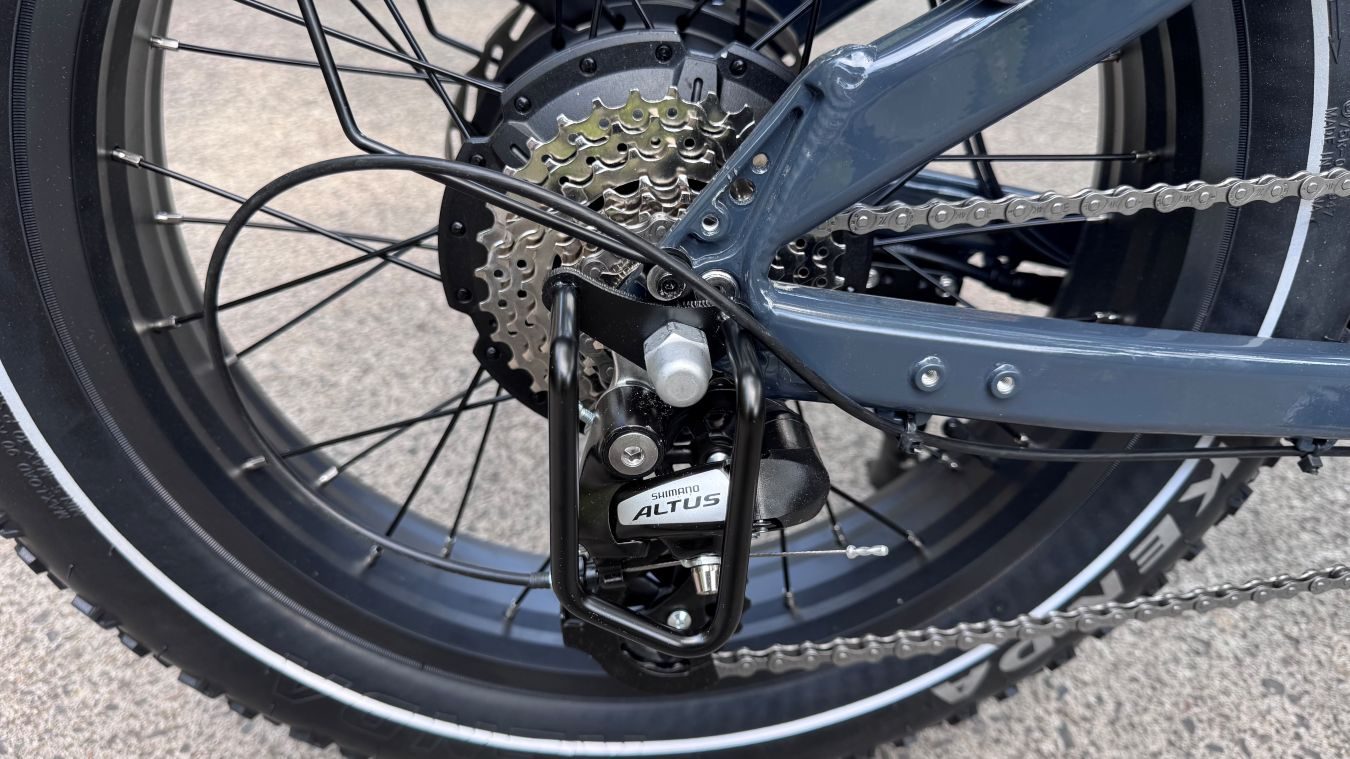
| Drivetrain | 8-speed. Shimano SL-M315 shifter and RD-M310 Altus derailleur; DNP 13-32T cassette; PRO-R42P 42T crankset, 152mm arms |
| Front suspension | ZOOM 879DH coil fork, no lockout or rebound. Travel: Kingbull’s product page says 100mm; its technical specifications page and launch release both say 80mm |
| Rear suspension | DNM AO-38RC air shock, 50mm, rebound adjustment and lockout |
| Tires | Kenda K-1188, 20 x 4.0 inches |
| Frame | Aluminum, full suspension, low step-through, internal routing |
| Weight | 81 pounds with battery |
| Payload | 450 pounds total; 150-pound rear rack |
| Seat height | 33.5 to 36.6 inches (3.1 inches of adjustment) |
| Rider height range | 5’3″–6’7″ claimed by Kingbull |
| Display | 4-inch color KB35H, integrated horn |
| Water resistance | IPX6 (no dust rating) |
| Charger | 3.0A UL-certified. Kingbull publishes no charge time; eBikeDaily reports 6–7 hours |
| Price | $1,499 as of September 10, 2026 (list $2,499) |
Design, Build & Fit: A low frame that fits fewer people than it claims
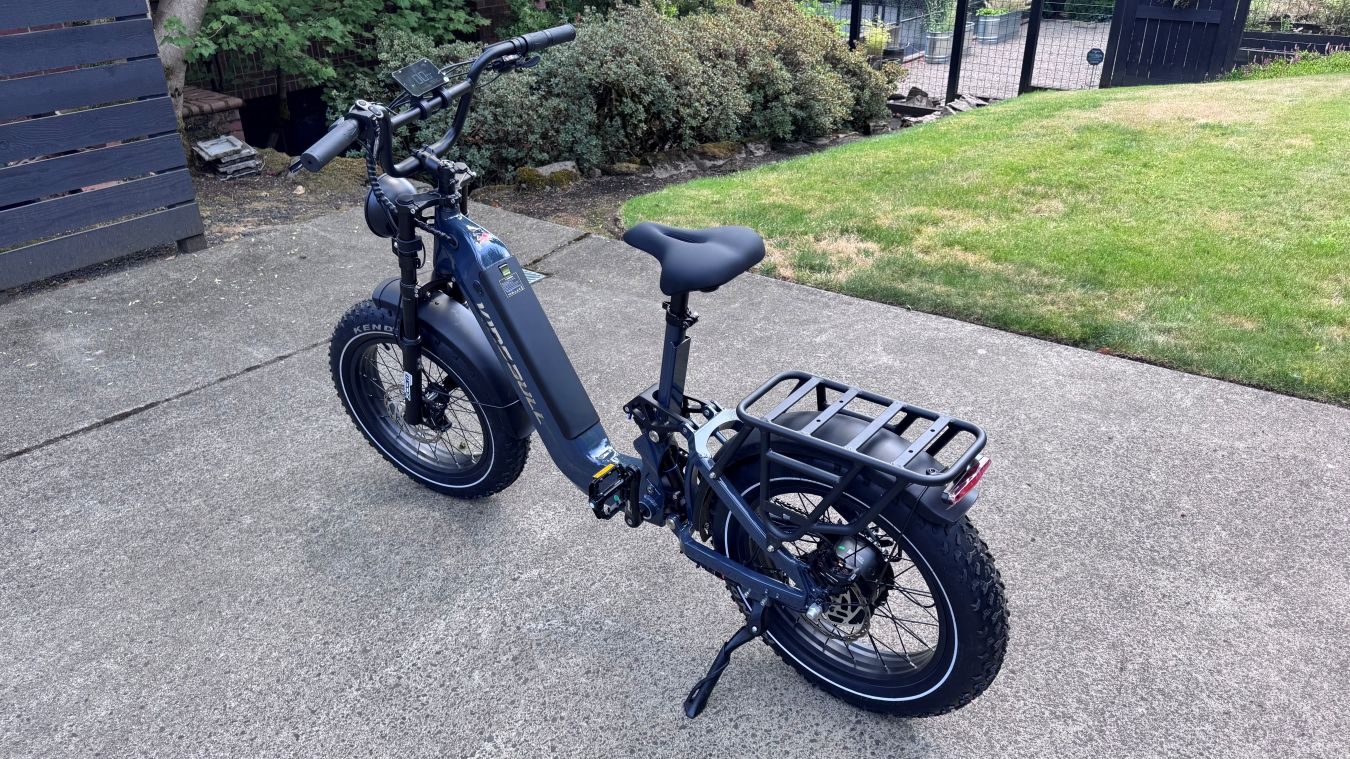
On first inspection after getting the bike out of the box and assembled, I can see that the Jumper Go looks more expensive than it really is. Welds are solid and clean, cables run internally, and the battery disappears into the downtube instead of bolting on as some of the lower-end bikes do. As I mentioned before, what I appreciated most in the daily use was the low step-through frame that I prefer for city bikes where you will be stopping at lights, stop signs, and can put both feet on the ground easily.
The Kenda 20 x 4.0 tires give the Jumper Go a slightly cartoonish yet very cool stance, and even the bulky-looking rear rack is rated for 150 pounds, which is super odd to me (in a good way) and more than most bikes in this class. I love the look of it too.
On the fit side, the big glaring issue that stood out for me is the seat post height. Kingbull advertises a rider height range of 5’3″ to 6’7″. The seat post offers 3.1 inches of adjustment, from a 33.5-inch minimum seat height to 36.6 inches. I’m 5ft 10 inches tall, and while the seat post adjusted for me, anyone over 6”3 is likely to have issues. Kingbull needs to fix this, as it can be a serious issue, and I’m not sure the frame even has room for a longer post, though, which means the solution is probably a narrower published range.
Score: 7/10
Motor & Performance: The torque sensor is a premium touch
A lot of e-bikes at this price use what’s called a cadence sensor, which works by detecting you turning the pedals, and when the motor decides you’re pedaling, it powers the motor whether you want it to go or not. That’s why cheap e-bikes lurch away from stop signs. The Jumper Go uses a torque sensor, which measures how hard you’re pushing and scales assistance to match – at least in theory. Theoretically, power arrives in proportion to the torque, so the bike feels like a bicycle you happen to be strong on rather than a scooter with pedals attached.
The 750W Bafang rear hub has no trouble with steep grades. I never found a hill in my testing that made it hesitate, and acceleration from a stop is quick and smooth instead of violent. As I have mentioned in several of my eBike reviews before, I live in a hilly neighborhood, with some steep grades. Some eBikes struggle with the inclines, but the Jumper Go didn’t have any issues. Sure, I had to pedal at some of the steepest inclines to keep momentum going, but the bike did just fine with little effort and no sweating on my part.
Kingbull does offer a speed modifier for $49, which will let you unlock Class 3 performance and a top speed of 28MPH with Pedal assist. Alternatively, you can go to the Kingbull website, and they give you a “secret” unlock instructions menu on the display if you want to try speeding the bike up that way as well.
Score: 8/10
Ride Quality & Handling: Suspension that earns its place, until you lean it over
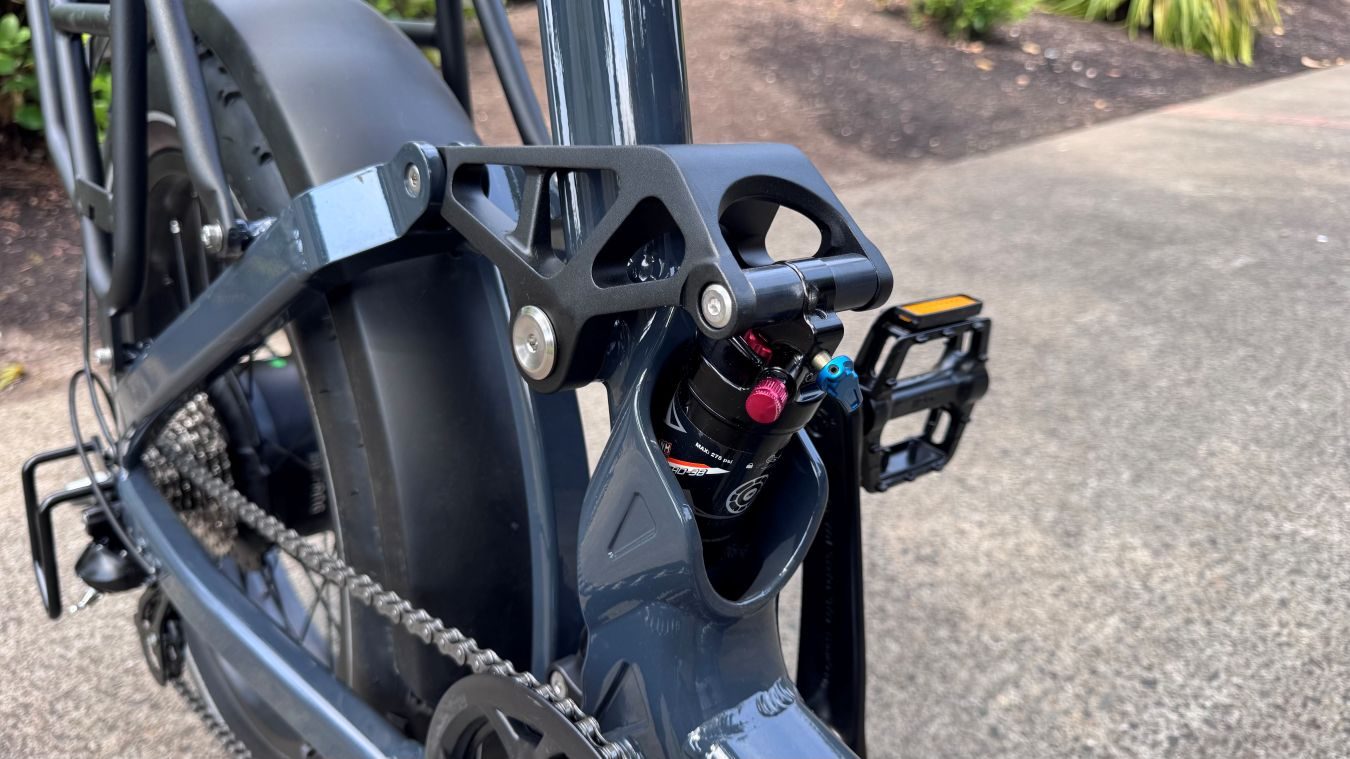
Because of the dual suspension, I found the ride on the Jumper Go to be quiet and composed while doing my city riding. The bike took potholes and dips with ease, with zero issues. Gravel and hardpack trails felt good as well for me. The bike tracks straight and corners predictably for something this heavy; it didn’t get skittish or lose traction on loose surfaces. The leather saddle is comfortable, and I didn’t experience any hot spot discomfort while testing the bike.
Two issues that could matter to people came up in my testing, though. First, the ZOOM coil fork doesn’t have rebound adjustment, and there is no lockout, and I bottomed out on some real rough riding over curbs and on the trail. An adjustable air fork would let you change the stiffness to help prevent bottoming out, especially if you are going on some off-road trails AND you happen to weigh more (I weigh 215lbs). I also found that because of the low ground clearance, my pedals struck the ground when taking some hard corners on rough terrain. It’s very clear that the Jumper Go is not meant to be a competitive mountain bike, and the full suspension might trick you into thinking it is. This is a comfortable all-surface cruiser that will handle trails on a casual level, not one where you would need a dedicated mountain bike; there are better offerings for that.
Score: 9/10
Battery & Range: The 80-mile claim with an asterisk
The Jumper Go uses a high-quality 960Wh Samsung battery, which is larger than the 733Wh pack in the Aventon Aventure 3 and on par with the Lectric XPeak 2.0. You remove the battery from the downtube with a dual lock, and you can charge the battery on or off the bike, which is a nice convenience. It took me close to 7 hours to charge the battery with the included 1-amp charger.
Kingbull claims you can get 80 miles of range with the Jumper Go under “ideal riding conditions,” which basically means those “conditions” are not realistic. In my testing, I was able to push 70 miles of range on flat roads in pedal assist 1 and 2, but most people will not be on flat roads. In combined riding throughout the Portland, Oregon area, I averaged around 40 miles of range on assist level 5 up and down hills and flat areas. In “Ecomode” I was able to push 57 miles of range on mixed terrain but had to pedal pretty hard on some steep hills. The Portland area is known for being very hilly, so that has an impact on range.
Score: 8/10
Brakes & Safety: The best component on the bike
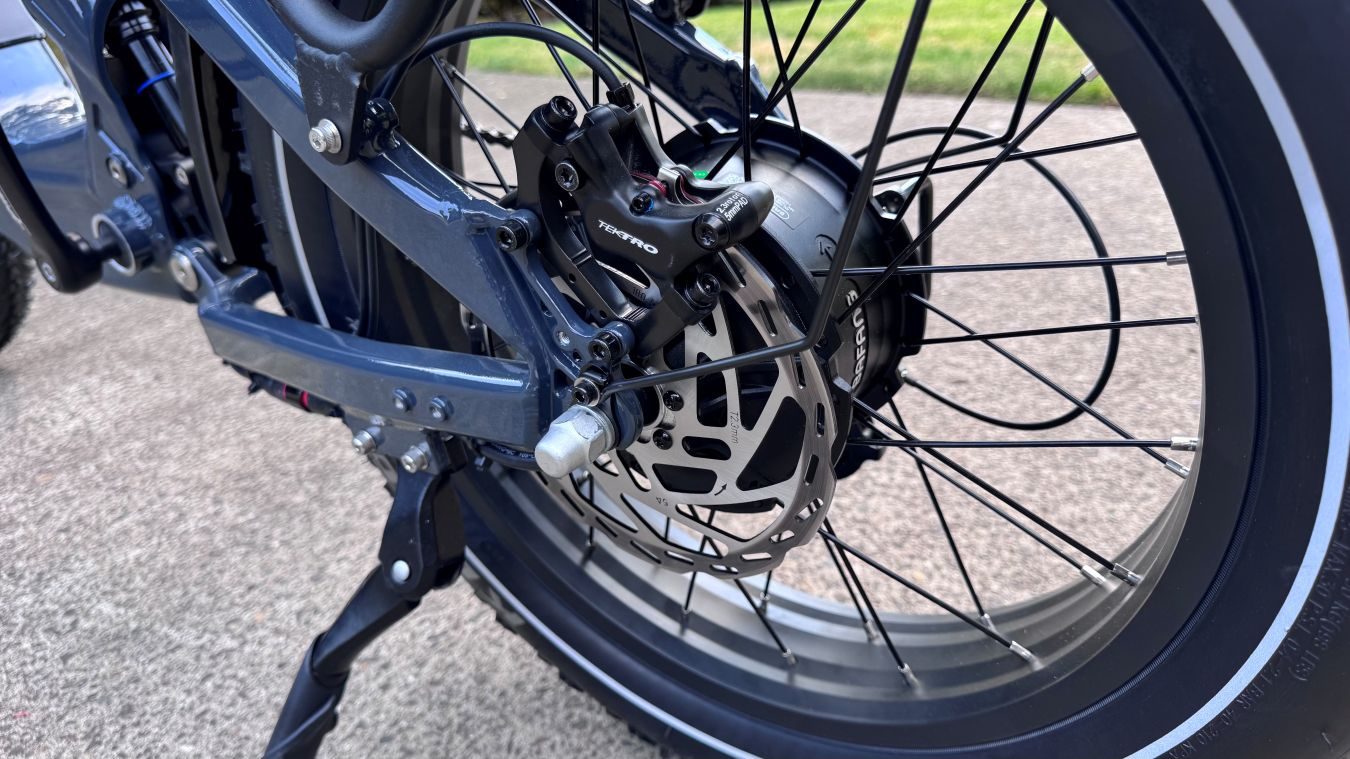
The Jumper Go weighs around 81 lbs. and can technically go up to 28MPh with the speed hack that turns it into a class 3 bike. That means with someone like me on it that weighs over 200lbs, you need some serious brakes. A lot of bikes in this category come with two-piston brakes, but Kingbull has added Tektro HD-E3940 four-piston hydraulic brakes with 180mm rotors on both the front and the rear. Braking power is adequate and linear and was predictable for me without being grabby. On steep downhill descents where I would lean on them hard, I experienced no brake fade from the heat and zero change in the brake lever feel. They worked as they should.
Score: 9/10
Display, App & Connectivity: Functional and bright, but missing a connection
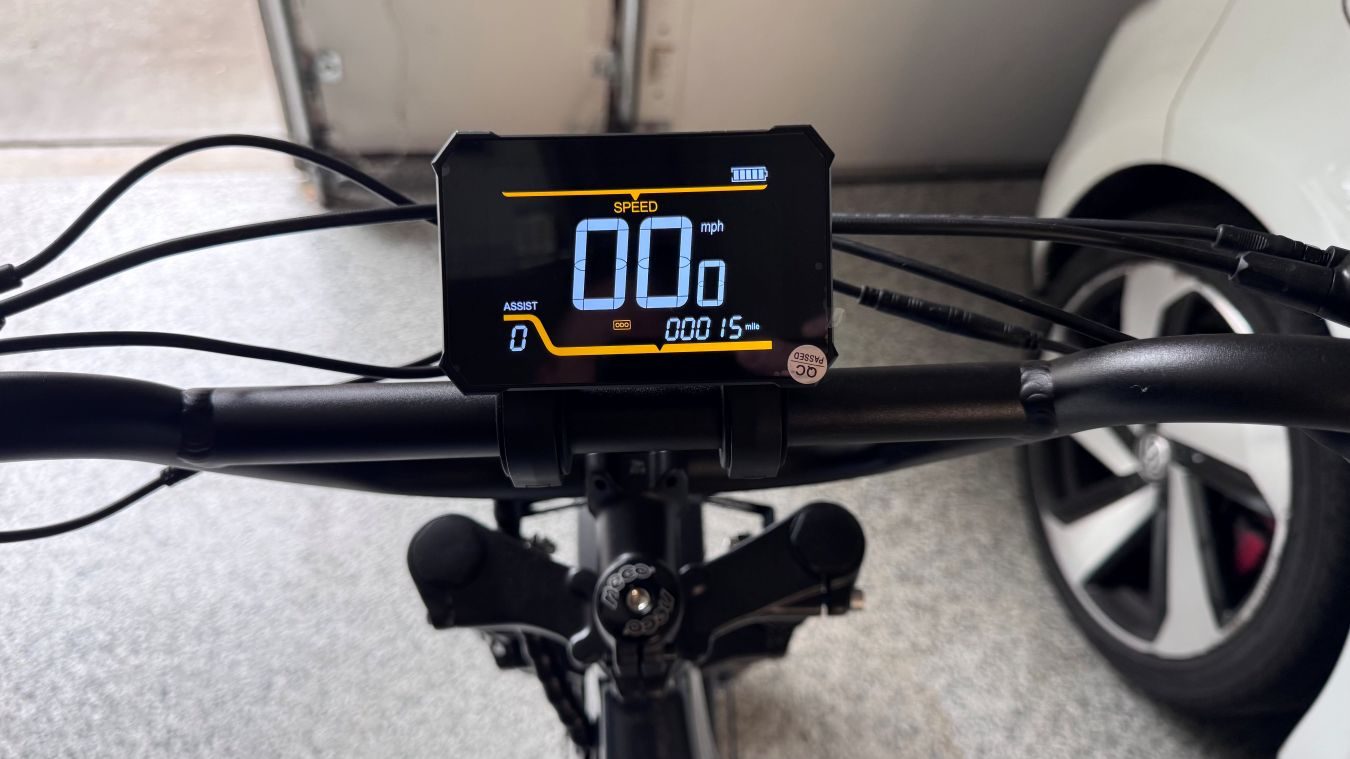
I found the color display to be adequately bright in the direct sunlight. You get speed, pedal assist level, battery state, and trip data on the main screen where you would expect. To change the pedal assist level, there is a thumb pad you can reach without moving your hand off the handlebar grip. Going into the P08 menu setting is where you can change the speed limiter if you want to convert the bike between a Class 2 or Class 3 capability.
There is an integrated horn in the headlight which is louder than a bike bell and more useful in traffic than I expected. Lighting runs off the main battery, so there’s nothing to charge separately, and the taillight brightens under braking. There are two lighting settings, standard and high beam.
Where the Jumper Go falls short for me is in the upgradeability department. Unlike the Hynox Trooper Go I just reviewed, there isn’t a companion phone app, no GPS tracking, or a firmware update path for the bike in case there are issues a software update could fix. And to be truthful, most bikes I have ridden or researched in this price range have an app companion, but they aren’t typically that good. But having one is better than not and something Kingbull needs to improve on.
Score: 7/10
Assembly & Maintenance: Eighty percent done, and the last twenty percent is on you
Kingbull says the Jumper Go arrives 80% put together, and I think that sounds about right. It’s the last 20% that can be a pain in the butt to complete. The bike comes with a nice tool kit, a cheesy tire pump (you should buy a nice portable electric one if you don’t already), and some zip ties (which is a nice touch).
I seem to be on a streak lately with the eBikes I have been reviewing. Like the recently reviewed Hynox Trooper Go, the instructions that come with the Jumper Go are very thin and left me with doing some guesswork. The headlight installation specifically was difficult for me to figure out for some reason, and I found a couple of screws missing from the kit, which turned a ten-minute job into a trip to Home Depot.
Once the bike was put together, maintenance is mostly conventional and routine. You can service the Shimano shifter and derailleur and the Tektro hydraulic brakes at any bike shop. The rest might be a little more difficult to service since Kingbull looks to only have a few US dealers, all of which are in California. Otherwise, they would have to ship the parts to you.
Score: 6/10
Durability & Warranty: Warranty that’s all over the place
Kingbull markets a 2-Year Warranty for the frame, motor, battery, controller, and wiring, which is competitive at this price point. There is a warranty table that lists all of the warranty lengths for each part, and it gets pretty confusing. The display gets 1 year. The hub gets 1 year. The fork gets 1 year, covering suspension system failures. The charger gets 6 months. The brake system, four-piston Tektros, gets 3 months. Tires get 3 months. 2 years on the rear suspension.
If the bike shows up not working at all, you have 15 days to notify Kingbull. Local repairs need prior approval and are reimbursed up to $75, and unauthorized work can void coverage.
Score: 8/10
Verdict: Should You Buy the Kingbull Jumper Go?
The Kingbull Jumper Go has plenty of character and is an incredible value. It’s comfortable to ride, feels very planted, and is perfect for city riding and mellow trails. At $1,499, very little else pairs dual suspension, a torque sensor, and four-piston brakes. Plus, it’s a step-through, which is my personal preference, and it’s rare to see all of these features on a step-through eBike.
Skip the Jumper Go if you are a very tall person, plan on doing some hardcore mountain/trail riding, and worry about service from your local bike shop.
For me, I have a soft spot for bikes with character, and the Jumper Go definitely has character. I love the design with the huge solo headlight and the bulky rear rack. Right now, the Jumper Go and the Hynox Trooper X are my favorite step-throughs, although the Hynox bike’s torque is for more confident riders, making the Jumper Go my easy go-to bike for now.
Overall Score: 8/10
How I tested
I rode the Kingbull Jumper Go as my primary bike across city streets, sustained climbs primarily in my neighborhood, gravel roads, and unpaved trails, in mixed late-summer conditions. Testing covered stop-and-go urban traffic, repeated steep descents on trail and in my neighborhood to evaluate brake fade, and off-road sections chosen to test ground clearance and suspension behavior. I assembled most of the bike from the box myself (had a professional assembler check out my work) and logged the tools, time, and problems involved. Battery range testing was assessed across all five assist levels.
Why Not Try…
Hynox Trooper X ($1,499) – It beats the Jumper Go on power, with a 100Nm torque sensor versus 85Nm, and it folds down for storage or a car trunk, which none of these other recommendations do. It matches the full front-and-rear suspension setup too, an 80mm hydraulic fork paired with an 80mm DNM air shock. The battery is a smaller 720Wh, though, and payload drops to 400 pounds with just a 66-pound rear rack rating versus the Jumper Go’s 150, and it’s a far newer, less established brand. If you love lots of torque and have hills around you, this would be the one to consider.
Lectric XPeak 2.0 Long-Range ($1,599) – It matches the Jumper Go’s 960Wh battery, uses a torque sensor, and hits Class 3 speeds. You give up rear suspension entirely and get an 80mm RST fork, and the payload drops to 330 pounds. The standard XPeak 2.0 is $1,399 with a smaller 720Wh pack.
Aventon Aventure 3 ($1,999) – Solid brand, better dealer network, better app, and it has a torque sensor of its own. It’s a Class 2 bike capped at 20 mph, though. The 733Wh battery is meaningfully smaller, and there’s no rear shock, just an 80mm fork and a suspension seatpost. You’re paying $500 more for polish and support.
Ride1Up Revv 1 FS ($2,095 on sale, $2,495 list) – While looking more like a motorcycle than a bike. The other 20-inch fat bike here with front and rear suspension, and it goes further with a 120mm dual-crown fork, 203mm rotors, and a 1,040Wh pack. It’s also 93 pounds, uses a cadence sensor rather than a torque sensor, and has no step-through version. Not the best comparison, but something to consider.









Leave a Reply